
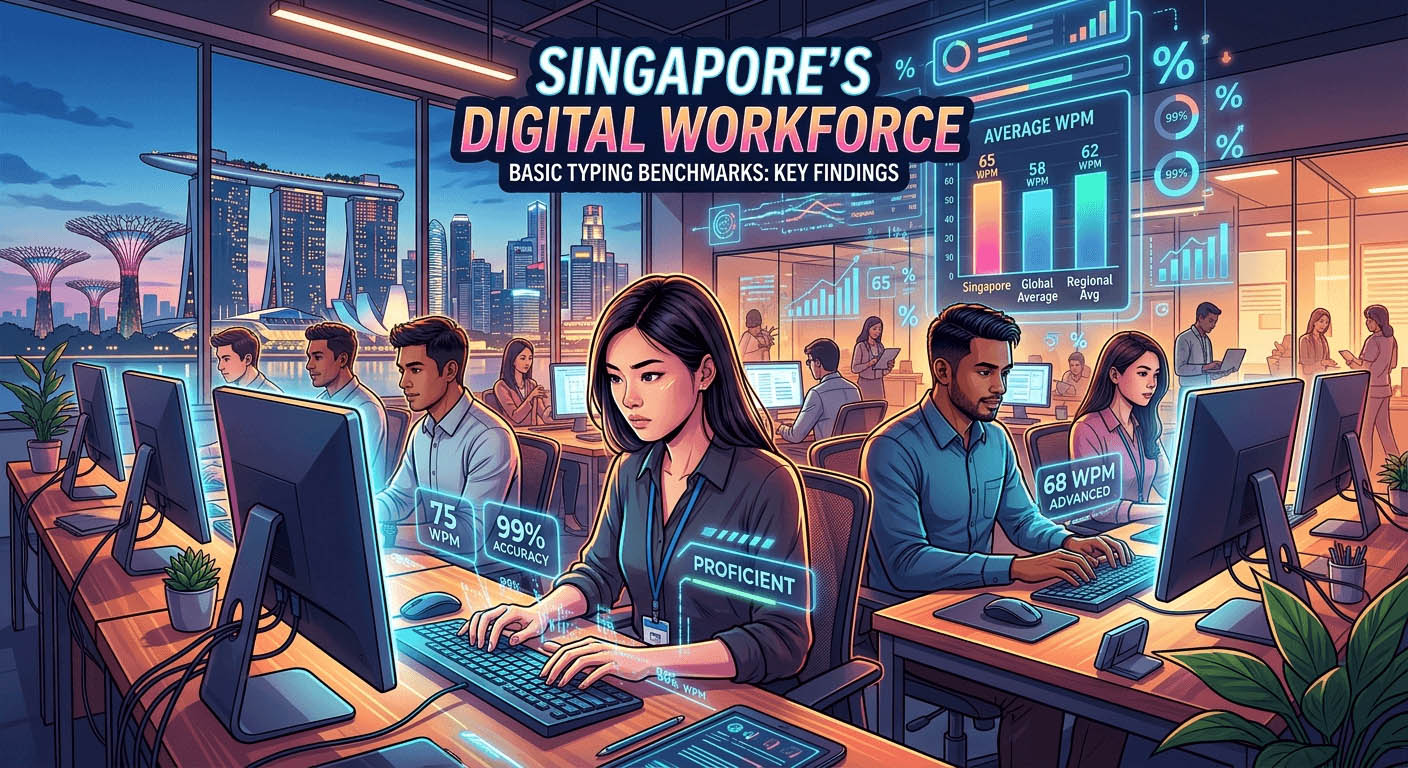
Singapore runs on keyboards. From fintech towers in Marina Bay to government agencies processing thousands of forms daily, the desk-based worker here is a fixture of the economy. But how fast do they actually type? And does raw speed even matter anymore? When you look at the data coming out of online typing platforms, a picture starts to form, one that is surprisingly revealing about how different generations of Singaporean professionals engage with digital work.
- Singapore’s professional workforce leans heavily on typing as a core daily skill.
- Average typing speeds among desk workers range from 45 to 65 WPM, with notable generational gaps.
- Format matters: context-rich tests better reflect real-world performance than random word drills.
- Global leaderboard data shows where Singapore sits against other high-productivity nations.
Why Typing Speed Still Matters in Singapore’s Digital Economy
There is a tendency to think typing speed is a relic of the secretarial era. That assumption does not hold up under scrutiny. Consider how a typical PME (Professional, Manager, Executive) in Singapore spends their day. Emails, Slack messages, reports, data entry, meeting notes. Research by workplace productivity analysts suggests that knowledge workers spend close to 40 percent of their working hours producing written output. That means every word per minute counts, even if it counts quietly.
Singapore’s white-collar sector is one of the most digitally intensive in Southeast Asia. The nation consistently ranks among the top globally for broadband penetration, smartphone adoption, and ICT infrastructure. Yet when you break down actual typing proficiency, the numbers tell a more nuanced story than the hardware specs suggest.
How Generational Habits Shape Keyboard Proficiency
Age is one of the strongest predictors of typing speed in Singapore’s workforce. And the reasons are cultural as much as biological.
Workers who grew up in the 1990s and early 2000s came of age during the MSN Messenger era. Fast typing was a social currency. If your reply took too long, the conversation moved on. That informal pressure built real speed. Many Millennials entered the workforce already typing at 55 to 65 WPM without ever taking a formal typing class.
Gen Z workers, the youngest cohort now entering offices, present an interesting split. Those who grew up primarily on touch keyboards show strong mobile text speed but sometimes lag on physical keyboards. Others, particularly those who gamed heavily on PC, enter the workforce with impressive typing benchmarks, sometimes hitting 80 WPM or more.
Gen X and Baby Boomer professionals typically range between 35 and 52 WPM. Many were trained on older input paradigms and adapted to keyboards later in their careers. Their accuracy rates, by contrast, often exceed those of younger colleagues, pointing to a trade-off between speed and precision that shows up clearly in benchmark data.
The Generational Gap in Numbers
Here is a breakdown of how different cohorts in Singapore’s professional sector generally benchmark across typing assessments:
Typical Speed Ranges by Generation
| Generation | Typical WPM Range | Key Influence |
|---|---|---|
| Gen Z (born 1997+) | 55 to 75 WPM | Gaming, social media, hybrid input |
| Millennials (1981 to 1996) | 50 to 65 WPM | Instant messaging culture, early internet |
| Gen X (1965 to 1980) | 40 to 55 WPM | Office computing, formal training |
| Baby Boomers (1946 to 1964) | 30 to 48 WPM | Later digital adoption, high accuracy |
Why Random Word Tests Do Not Tell the Full Story
Most people assume a typing test is a typing test. You type words, you get a score, done. The format of the test changes everything, though.
Random word lists are the most common format. They are also the least representative of actual work. No professional ever types 60 consecutive unrelated words in sequence. Real professional writing involves sentences, context, punctuation, and cognitive processing happening at the same time. Typing “the quick brown fox” as a loop is fundamentally different from composing a client brief.
This is where passage-based testing changes the picture. Trying a quotes test puts the typist inside a real sentence, with grammar cues, familiar phrases, and natural rhythm. For professionals, this format exposes something a random word drill never will: whether their typing actually keeps pace with their thinking. Many Singaporean desk workers score noticeably lower on passage-based tests than on random word tests, because the cognitive load of reading and typing simultaneously is closer to how actual writing feels.
HR professionals and L&D teams in Singapore who use typing benchmarks for hiring or assessment purposes are increasingly moving toward this format for exactly that reason. The score is more predictive of real-world output speed.
Six Factors That Shape Typing Performance in Singapore’s Offices
- Keyboard type: Mechanical keyboards produce faster results on average. Many corporate offices in Singapore still use membrane keyboards, which create slight speed penalties.
- Language switching: Singapore professionals frequently switch between English, Mandarin, and Malay in a single workday. This context-switching taxes cognitive throughput.
- Screen time volume: Workers who spend 6 or more hours daily typing tend to plateau around a personal ceiling without deliberate practice.
- Home row habits: A significant portion of even experienced desk workers in Singapore type without using proper home row technique, which caps maximum speed.
- Voice-to-text adoption: The growing use of AI transcription tools in meetings means some professionals are actively typing less, which gradually affects muscle memory and benchmark scores.
- Mobile-first habits: Workers who primarily communicate via mobile throughout the day sometimes find their desktop typing speed declining over time.
How Singapore Stacks Up Against the Global Pool
Competitive typing data is one of the more honest lenses through which to view digital skill gaps between countries. When you browse the typing leaderboard, the distribution of scores across participating countries reveals a clear pattern. Nations with strong formal keyboarding education in schools tend to cluster higher on average scores. Singapore sits in a respectable middle tier, not at the top of the global distribution but well ahead of the regional average for Southeast Asia.
What stands out is the accuracy-to-speed ratio of Singapore’s participants. Singapore-based users tend to record lower error rates compared to peers with similar speed scores from other countries. This tracks with the education culture here. Schools have always rewarded precision over speed, a value that apparently carries into professional digital habits.
The top global performers on leaderboards are often from Scandinavian countries and South Korea, where touch typing has been embedded in school curricula for decades. Singapore introduced ICT literacy programs through SkillsFuture and school-level computing education, but formal typing instruction has been inconsistent.
What the Data Actually Tells HR and L&D Teams
Typing benchmarks are rarely used in Singapore hiring beyond roles explicitly requiring data entry or transcription. That may be a missed opportunity. Consider what WPM scores reveal:
- A candidate typing at 35 WPM will spend roughly twice as long on written communication tasks as one typing at 70 WPM.
- Over a 40-hour work week, that gap compounds. The slower typist effectively loses multiple productive hours every week compared to a faster colleague doing the same written tasks.
- Accuracy scores predict error frequency in documentation, which has downstream effects in fields like finance, legal, and healthcare administration.
- Speed under passage-based conditions correlates more closely with on-the-job written output quality than raw word list scores.
None of this means slower typists are less capable. But for roles that are primarily keyboard-driven, these benchmarks carry real predictive weight.
Practical Ways Singapore Professionals Can Improve Their Scores
Improvement does not require expensive courses or dedicated hours of practice. Consistent, targeted short sessions work better than long unfocused drills.
- Start with your baseline: Run a timed test under standard conditions. Do not guess your speed. Know it precisely.
- Fix your posture first: Wrists floating above the keyboard, screen at eye level. Physical alignment affects speed more than most people realise.
- Use passage-based tests for training: Random word tests train for a test format. Passage-based formats train for real work.
- Practice for 10 minutes daily: Consistency beats intensity. Daily short sessions build muscle memory faster than occasional long ones.
- Target your weak keys: Most people have a handful of keys they always fumble. Identify them and drill specifically.
- Track accuracy, not just speed: Many typists push speed by sacrificing accuracy, which backfires. Keep error rate below 2 percent before pushing WPM higher.
Where Keyboard Culture in Singapore Is Heading
Voice inputs, AI autocomplete, and predictive text are all chipping away at the primacy of typing in digital communication. Some workplace commentators argue that keyboard benchmarks will become irrelevant within a decade. That argument has been made before, and keyboards keep surviving.
The more likely future is hybrid. Professionals will type less volume overall as AI handles drafts and transcriptions, but the typing they do will need to be faster and more precise, because it will be for higher-stakes review, editing, and refinement tasks. The quality bar for what professionals type, rather than what they dictate, will rise.
Singapore’s workforce is well positioned for that shift. The culture of precision already embedded in professional habits here provides a strong foundation. The gap to close is speed, particularly in the 45 to 55 WPM band that characterises a large portion of the mid-career professional population.
What the Numbers Mean for Singapore’s Desk-Based Future
Typing benchmarks are small data. A single score tells you very little. But aggregate data across a workforce tells you something real about how digital habits form and where they fall short. Singapore’s professional community sits at an interesting crossroads. Strong foundational precision, moderate average speed, generational divergence in technique, and a growing awareness that format matters when measuring real-world skill.
The biggest takeaway is not the average WPM number. It is the gap between what workers score on random word tests and what they score when tested on real sentences under realistic conditions. That gap is where productive capacity actually lives. Closing it, even partially, has measurable output implications for individuals and organisations alike.
The benchmark data exists. The tools to improve are accessible. What remains is whether Singapore’s workforce, individually and collectively, decides to treat typing speed as a professional skill worth measuring and maintaining rather than a background habit assumed to be good enough.









Leave a Reply